
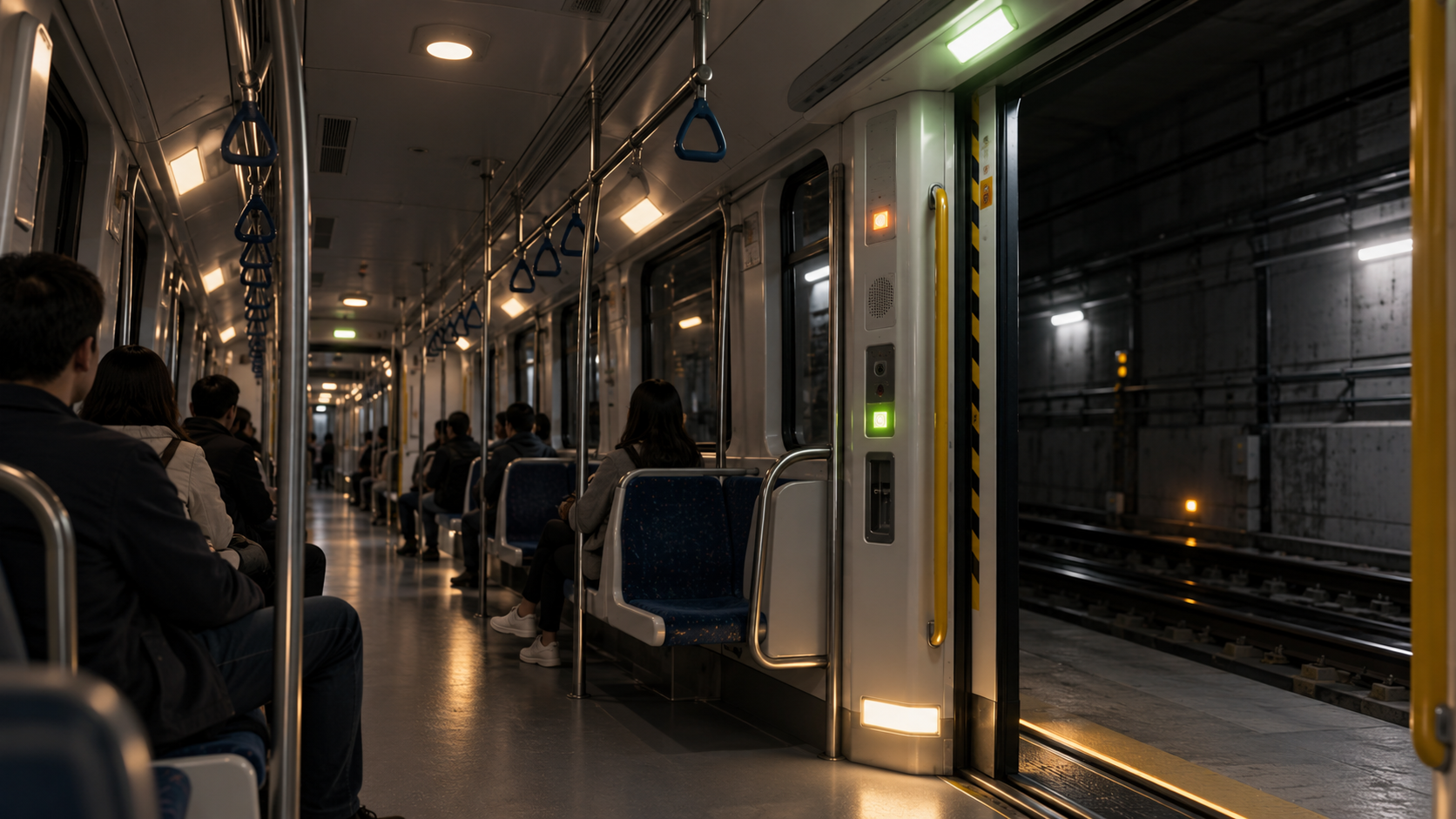
How do metro train lights and doors work during a power failure?
When the main supply to a metro line fails, not all onboard systems have to shut down together. The vehicle battery supports critical loads such as emergency lighting, communications, control circuits and certain door functions for a defined period. The equipment supported and its runtime depend on vehicle design and operating requirements.
Onboard batteries for railway and metro applications are part of EKA System’s work. They are more than energy-storage components: when the main train supply is lost, they keep many auxiliary systems needed for safe operation running.
Where does the train’s main power come from?
During normal operation, metro trains take power from infrastructure such as a third rail or overhead contact line. This energy supplies traction and auxiliary systems. If the line supply fails, traction power may stop.
The onboard low-voltage auxiliary power infrastructure and battery bank then continue to supply loads important to safety.
Why do the lights not go out completely?
Emergency lighting is one of the most basic backed-up loads for passenger safety. Normal interior lighting may not continue at the same level after a main power failure, but emergency lighting circuits can be powered by the battery.
Parts of passenger information, public-address, communications and control systems can also be included in the backup-power scope.
How do the doors open?
Door systems may be electrical, pneumatic or a combination. They must remain safely controlled during a power failure. The vehicle battery can support door controls and, depending on the design, the auxiliary functions needed to open the doors.
This does not mean every train operates all doors indefinitely from its batteries. Required functions and duration are determined by the vehicle manufacturer’s design criteria and operating scenario.
Why are Ni-Cd batteries used?
Railway batteries must operate reliably under vibration, temperature variation, high-current demand and long service-life requirements. Ni-Cd technology has therefore been used in many railway applications for decades.
Onboard battery sizing considers more than Ah capacity. Emergency loads, runtime, minimum voltage, temperature, ageing allowance and relevant railway standards are evaluated together.
The emergency lighting and door controls passengers see during a metro power failure are the result of a correctly designed auxiliary DC system and battery bank.