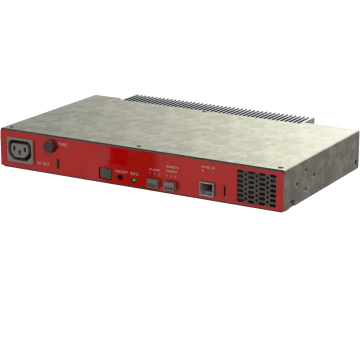
Product description
An industrial power system converting energy from an existing DC bus or battery into controlled AC voltage and frequency.
 Request a quoteTR
Industrial inverters generate critical AC power from an existing DC bus or battery system. The DC input range, output waveform, transient loads and bypass requirement determine the design.
PRODUCT AND TECHNOLOGY
An industrial power system converting energy from an existing DC bus or battery into controlled AC voltage and frequency.
The semiconductor switching stage converts DC input into an AC waveform. Filtering and the control loop maintain output quality as the load changes.
Fans, capacitors, filters, power connections and bypass components are monitored. Capacity adequacy is reassessed when loads change.
APPLICATIONS
TYPICAL OPTIONS
Values and options are for initial selection. Final values are determined after the selected product, manufacturer data, specification and site conditions have been verified.
SYSTEM ARCHITECTURE
PROJECT INPUTS
Unknown values can be clarified through site inspection and engineering before quotation.
Minimum, nominal and maximum DC bus voltage
Load kW/kVA, power factor and starting current
Output voltage, phase and frequency
Bypass source and transfer requirements
Mechanical and environmental requirements
TECHNICAL QUESTIONS
Selection should not be based on nominal power alone without verifying starting, harmonic and power-factor characteristics.
Where a reliable DC bus already exists, it may provide a suitable solution for specific critical AC loads.