Compact installation
Assess cabinet space and the installation layout together, using modules suited to the energy and power requirements.
 Request a quoteTR
Lithium-ion battery systems for industrial energy storage and uninterruptible power applications. Assess cell chemistry, BMS, power electronics and operating conditions together to select a suitable solution for your project.
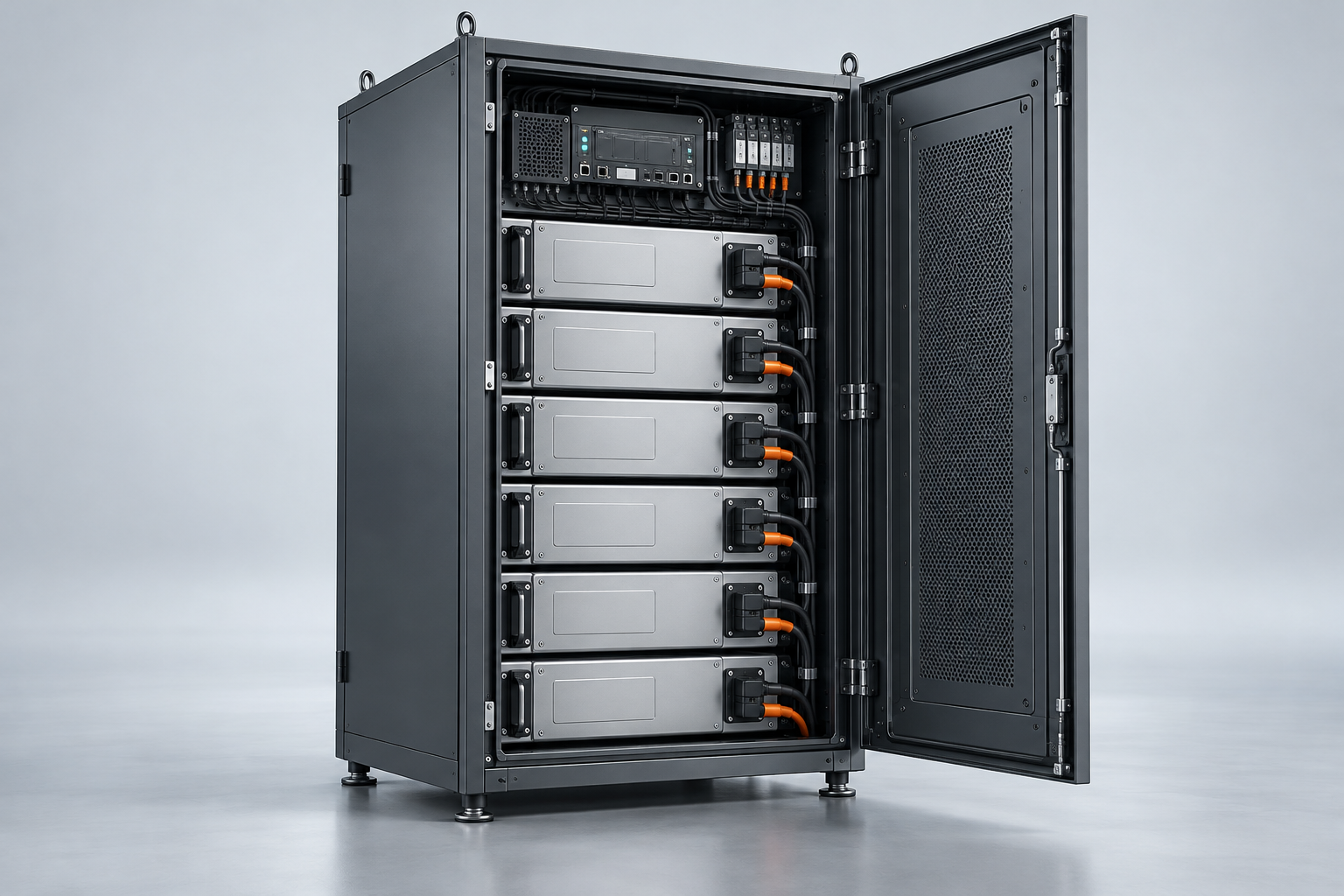
Cell capacity alone does not determine Li-Ion performance. Every component, from cells to protective devices, must operate together.
Lithium-ion batteries store electrical energy electrochemically. During charging and discharging, lithium ions move between the electrodes. Cells connected in series and parallel form modules that provide the voltage, capacity and power required by the application. Together with monitoring, protection, communication and connections, these modules become a battery system.
High energy density, modular construction and fast-charging capability in suitable designs make Li-Ion an option for projects where space is limited and energy continuity matters. However, two systems with the same nominal capacity may differ in usable energy, permitted current and cycling performance. Selection must use product technical data and the actual load profile.
Assess cabinet space and the installation layout together, using modules suited to the energy and power requirements.
The BMS tracks cell voltage, temperature, current and system status.
Autonomy, cycling frequency, ambient conditions and equipment compatibility form the basis of selection.
Li-Ion does not refer to one cell chemistry. Selecting a suitable chemistry is the starting point for system design.
LFP is often considered for stationary energy storage because of its thermal stability and characteristics in cycling applications. It can be a suitable option for systems with regular charging and discharging. Safety, however, depends on more than chemistry: cell quality, protection, cabinet design and operating conditions also matter.
NMC can be considered where energy density and compact design are priorities. Space, weight, discharge power and temperature conditions must be assessed together. General chemistry characteristics provide guidance; the final decision must use the offered product’s datasheet, warranty conditions and performance verified for the application.
UPS backup and an energy storage system with daily cycling have different requirements. Short-duration high power may dominate the first, while usable energy and cycling conditions may dominate the second. Asking only “how many kWh?” is therefore insufficient.
The battery management system (BMS) supports operation within the battery’s defined limits.
Cell voltages, temperatures and system current are monitored. State-of-charge and health indicators are provided according to the product’s measurement and calculation methods.
Defined protection actions respond to overvoltage, undervoltage, temperature and current conditions. Fuses, contactors and other protective devices are designed together.
Managing differences between cells helps keep modules within appropriate limits. Balancing method and capability vary by product.
Required status information is exchanged between the BMS and UPS, inverter or energy management system. Protocol and alarm behaviour are verified with the equipment.
A BMS alone is insufficient for safe installation. Electrical protection, cabinet layout, thermal management, monitoring and the facility emergency plan must be considered together. Check applicable product and project testing, certification and local requirements at selection stage.
kWdescribes the instantaneous power requirement; kWh describes the energy required over a period. Ah describes electric charge and is insufficient on its own to compare batteries operating at different voltages. Check power and energy requirements separately when selecting capacity.
Actual sizing accounts for UPS or inverter losses, permitted operating range, discharge power, temperature and expected end-of-life capacity. Starting currents and short power peaks must also remain within the system’s permitted current. Verify selection using manufacturer discharge tables and equipment operating limits.
A larger nominal capacity does not always mean a more suitable solution. A high-energy system may not supply the required short-duration power. Similarly, a high-power battery may not provide sufficient energy for a long autonomy target.
A Li-Ion battery should not be treated as a universal direct replacement for an existing lead-acid battery. The UPS model must support lithium batteries, and compatibility with the selected battery system must be verified.
Connecting a system before completing compatibility checks can cause performance and protection problems. For conversions, include the equipment model, battery voltage and required autonomy in the quotation request.
Qualified teams must install the system according to manufacturer instructions. Assess cabinet dimensions, floor load capacity, service access, cable routes and ambient temperature in advance. Ventilation or cooling requirements depend on system heat losses and operating conditions.
At commissioning, check connections, protection, communication, alarm transmission and system behaviour. During operation, regularly review alarm history, temperature trends, module condition and manufacturer-recommended checks. “Low maintenance” does not mean a system can operate without inspection.
Life is affected by calendar age, temperature, state of charge, depth of discharge and usage frequency. Cycle counts are meaningful only alongside the stated test conditions. Plan replacement, transport and end-of-life procedures according to manufacturer instructions and applicable requirements.
| Criterion | Li-Ion | Lead-acid |
|---|---|---|
| Space and weight | Can provide compact solutions; depends on the product and power requirement. | May require more space and weight for the same objective. |
| Control and monitoring | BMS, protection and communication are core system components. | Monitoring scope depends on battery type and the installed system. |
| Equipment compatibility | Charging and BMS compatibility require separate verification. | May be established in existing equipment; voltage and charging compatibility still require checking. |
| Total cost | Assess initial investment, service, energy losses and replacement planning together. | Assess maintenance and renewal costs alongside initial investment. |
LFP is one cell chemistry within the lithium-ion family, which also includes chemistries such as NMC. Selection assesses the product’s technical characteristics rather than the technology name alone.
No single duration applies to every product. Ambient temperature, usage and manufacturer conditions are decisive. Review design life, warranty duration and end-of-life capacity separately.
No. The UPS model must be compatible with the selected battery system for voltage, charging, protection and required communication. Check manufacturer approval.
The BMS monitors cell conditions, performs balancing and protection functions and shares information with other equipment. It works with other protective components to support system safety.
Battery capacity, initial state of charge, permitted charging current and the charger determine charging time. Verify a fast-charging target against both battery and equipment limits.
Dimensions alone are insufficient. Check load capacity, connections, insulation, thermal conditions and service access. Follow module and cabinet manufacturer requirements.
This is possible in some modular systems. Assess module compatibility, age differences, parallel connection limits, BMS and power electronics capacity under the manufacturer’s expansion rules.
Initial assessment requires load power, target autonomy, equipment model, DC voltage, daily cycling requirements, ambient conditions and layout information.
Share your application’s power, energy and compatibility requirements with EKA System. We can review the data needed for technical selection together.
This information is a general selection guide; the product technical datasheet and manufacturer instructions take precedence.