
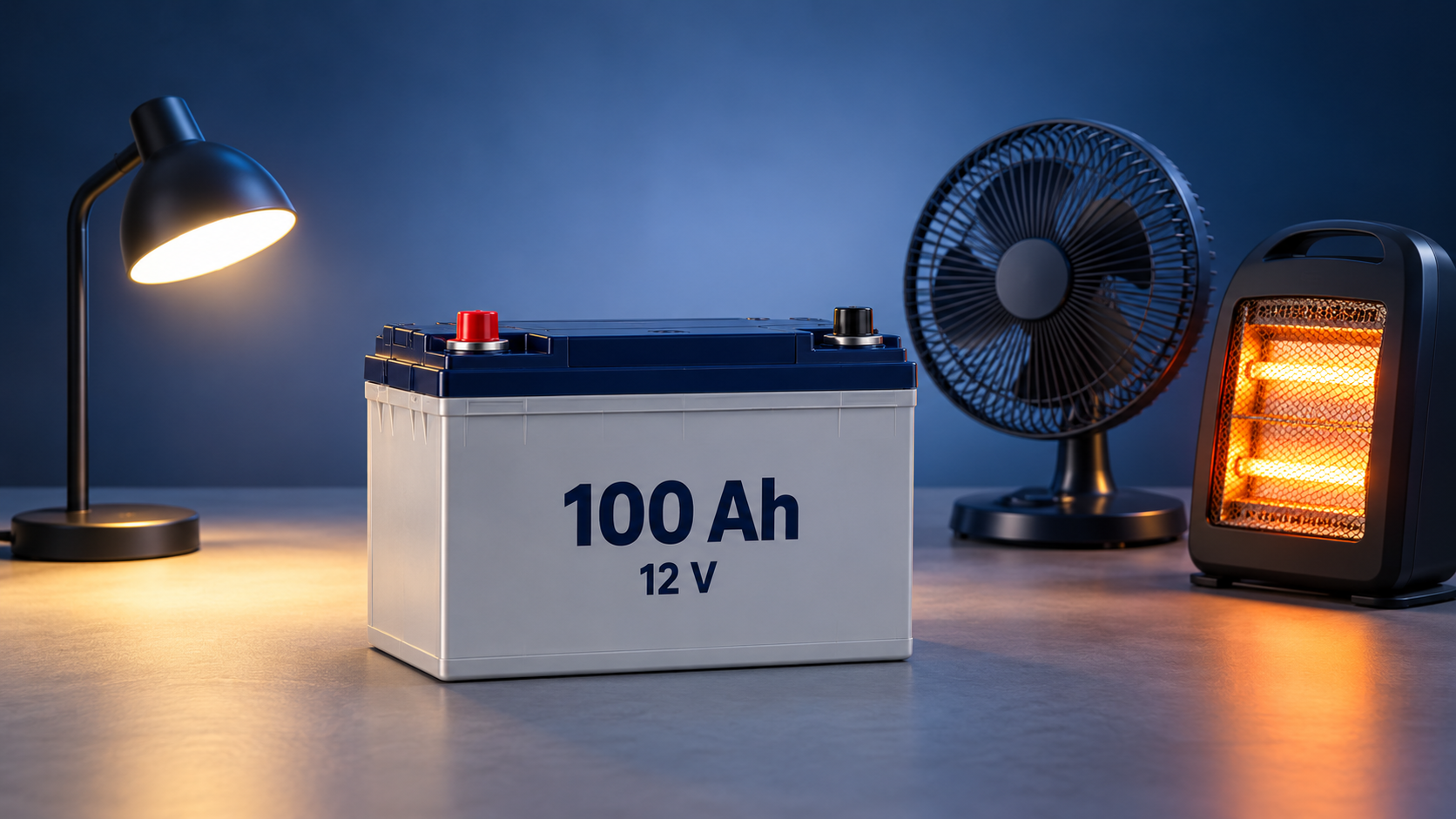
Does a 100 Ah battery run for the same time at every load?
No. A 100 Ah label does not guarantee identical runtime at every load. Actual runtime depends on current draw, discharge duration, end voltage, temperature, battery age and battery technology.
Battery sizing, UPS and industrial DC systems have been part of EKA System’s work for many years. A common field mistake is to use the Ah rating alone to conclude that a battery will last a particular number of hours.
What does Ah mean?
Ah, or ampere-hour, is a basic measure of a battery’s electrical capacity. It is measured under specified test conditions. The same battery can deliver different usable capacity at different discharge durations.
In lead-acid batteries, usable capacity during short, high-current discharges differs from that during longer, lower-current discharges. Ni-Cd cell series and designs are also selected for duty profiles such as long-duration low current, mixed loads or short-duration high current.
Why can simple division be misleading?
It is easy to assume that a 100 Ah battery will run a 10 A load for exactly 10 hours. In practice, that approach is insufficient for most critical-power applications.
Battery terminal voltage falls during discharge. If the system cannot operate below a minimum DC voltage, usable discharge time ends even if energy remains in the battery. The efficiency of inverters, UPS equipment and DC/DC converters also affects actual runtime.
Temperature and ageing must also be considered
Low temperature can reduce usable capacity. High temperature can shorten the service life of some battery technologies. An ageing battery also does not retain all of its initial capacity.
Sizing for critical applications therefore considers the expected operating temperature, minimum system voltage, ageing allowance and, where necessary, a safety margin, as well as the present load.
What is the correct method?
The most reliable method is to use the manufacturer’s performance tables for the specified temperature, end voltage and discharge duration. For variable loads, calculations should follow the actual duty cycle rather than assume a constant current.
A 100 Ah rating is a starting point. Determining actual runtime also requires answers to these questions: at what load, for how many hours, at what temperature and down to what minimum voltage?