
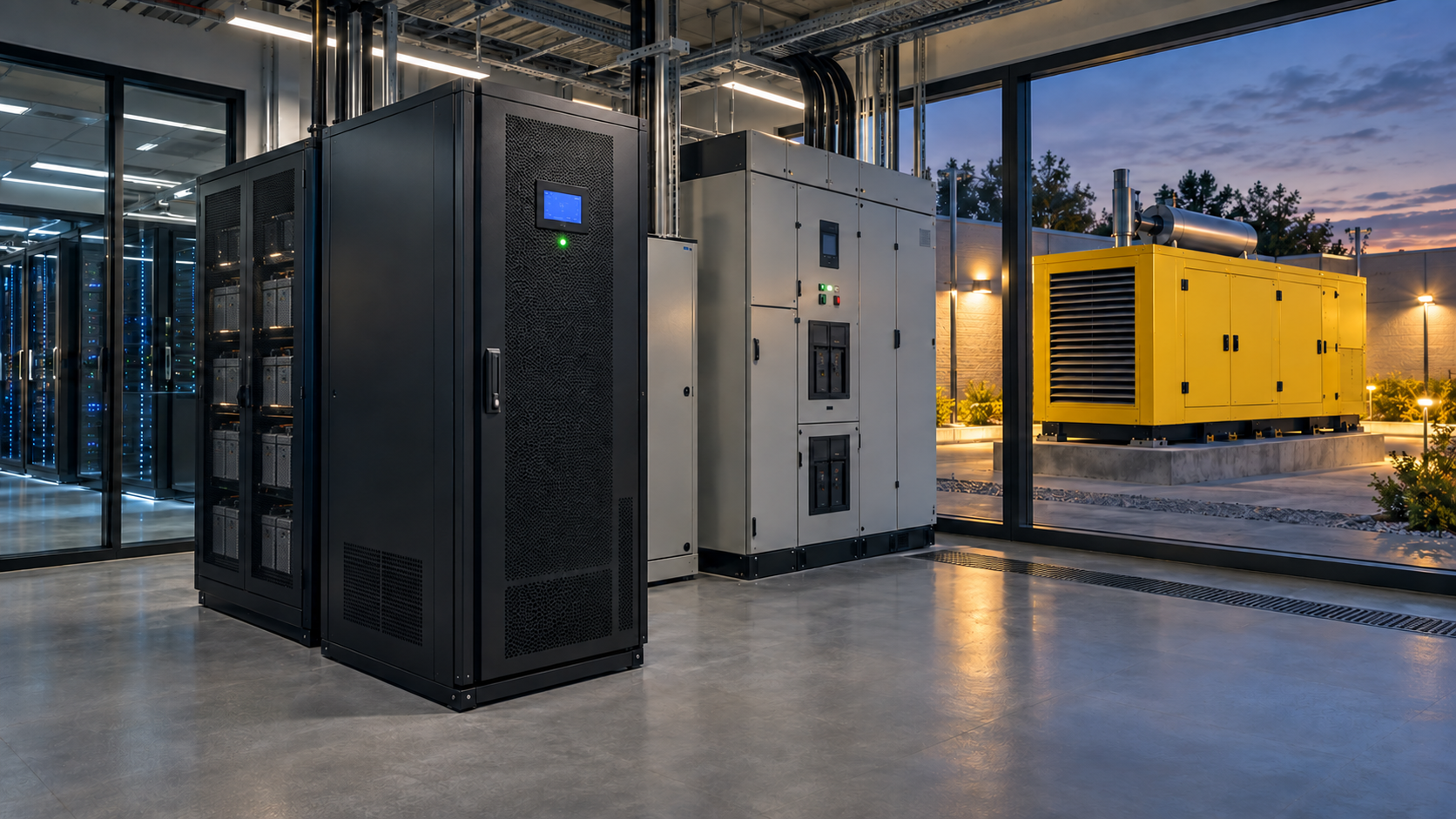
How does power continue until the generator starts?
A generator does not always take over the load immediately when mains power fails. The engine must start, reach stable operating conditions and accept the load. A UPS and battery system bridge this interval for equipment that cannot tolerate an interruption.
UPS, battery and industrial DC power systems have been part of EKA System’s work for many years. In hospitals, data centres, industrial facilities and control systems, the objective is not only to provide power for a long time, but also to prevent an uncontrolled interruption, even briefly.
Why is a UPS needed when there is a generator?
A generator can supply facility loads during extended outages. If it is not ready to produce electricity at the instant the mains fails, however, there is a period without power, even if that period is short.
A few seconds of interruption may simply restart an office computer. The same interruption in a critical controller, server, communications system or medical device can stop a process, cause data loss or require a system restart.
A suitably designed UPS continues to supply connected critical loads from its batteries when the mains disappears. Once the generator starts and provides a stable supply, the energy source can change while critical equipment continues operating through the transfer.
Are batteries used only for long outages?
No. A battery bank is not always intended to supply power for hours. Some systems need only enough autonomy to cover generator startup safely. Other applications require greater battery capacity because there is no generator or longer backup is needed.
UPS and battery sizing therefore considers required autonomy, load characteristics, system voltage, battery technology and operating conditions alongside the total equipment power.
The purpose is to manage the interruption
A generator and UPS need not be alternatives. In critical facilities, they can operate together as two layers with different duties: the UPS provides the uninterrupted transition, while the generator can meet longer-term energy demand.
This distinction explains why a UPS may be needed even with a generator. For a critical load, the important point is not only that electricity returns, but that the system keeps operating in the meantime.