
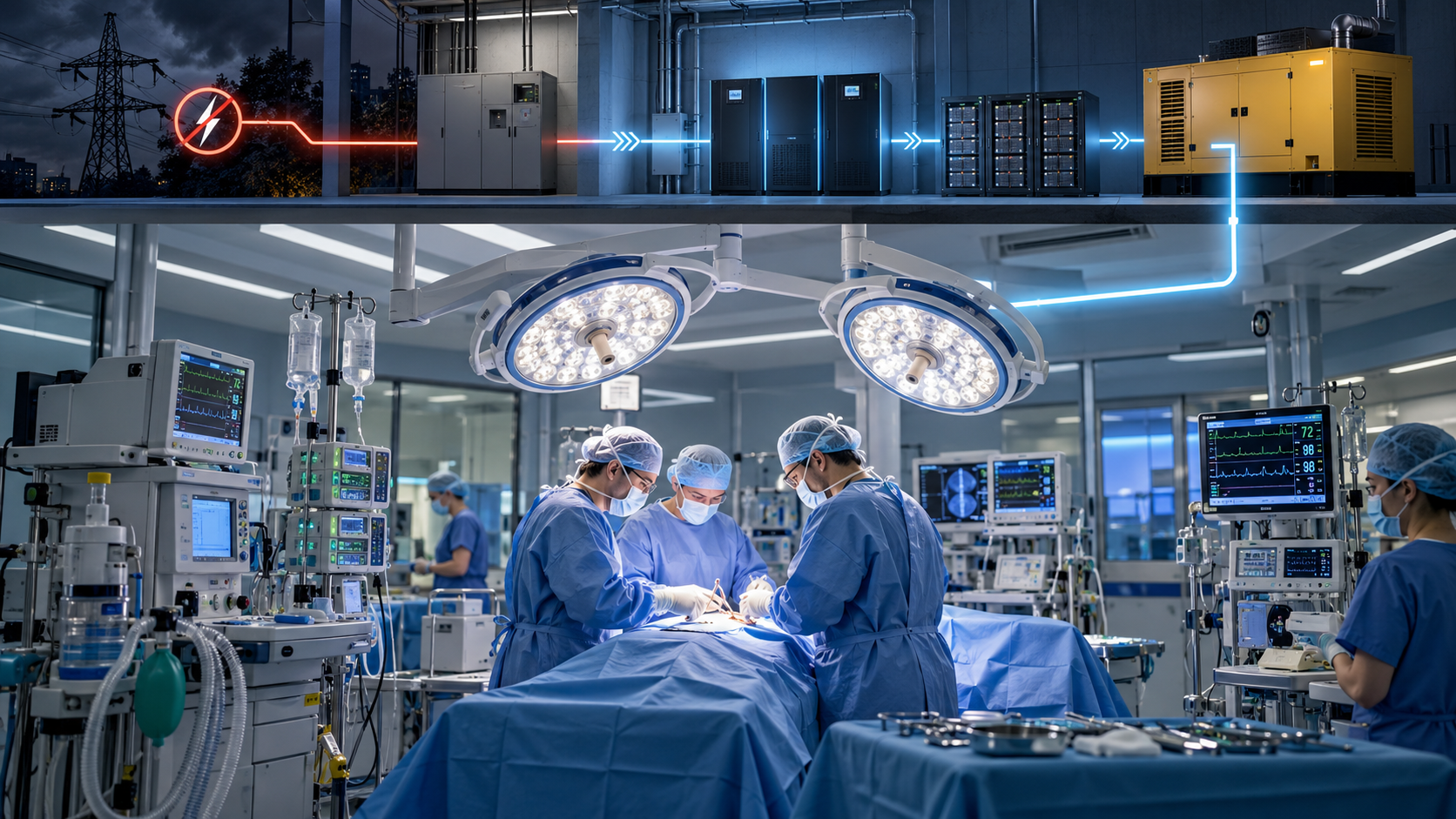
How does an operating theatre keep working during a hospital power failure?
Whether critical operating-theatre equipment continues working during a power failure depends on backup infrastructure designed in advance. UPS systems supply suitable critical loads at the time of failure, while generators can start to meet longer-term energy needs. Backup arrangements differ between hospitals and between devices.
UPS, rectifiers, batteries and industrial DC systems are part of EKA System’s work and form elements of critical-facility power-continuity infrastructure. In hospitals, design must consider patient safety and the nature of medical procedures as well as electrical outages.
Why might a generator alone be insufficient?
A generator can require time to start and take over the load after mains power fails. Even this short interval may be unacceptable for certain medical devices and control systems.
A UPS supplies connected loads using stored battery energy to prevent an interruption during the transfer or keep it within the equipment’s permitted limits. Once the generator starts under suitable conditions, it can provide longer-term power.
Which devices receive backup power?
Operating-theatre lighting, patient monitoring and other electrical equipment needed for a procedure are connected to suitable safety supplies according to the medical risk assessment. Some devices also have internal batteries.
Not every socket, light and device in a hospital should be assumed to share the same UPS. Critical loads are identified, required autonomy is calculated and distribution is arranged accordingly. Redundant supplies, appropriate protection and, where required, electrical-safety solutions specific to medical areas are evaluated together.
How is battery capacity selected?
Battery autonomy matters as much as UPS power. Selection considers actual critical-device consumption, required runtime, battery characteristics, environmental conditions and the operating scenario.
Regular inspection of batteries and backup equipment is as important as design. A generator that does not start, a battery with reduced capacity or a UPS that is out of service cannot deliver the expected protection when needed.
Operating-theatre power continuity results from correctly classified critical loads, suitable backup sources and regular maintenance working together, rather than from a single device.