
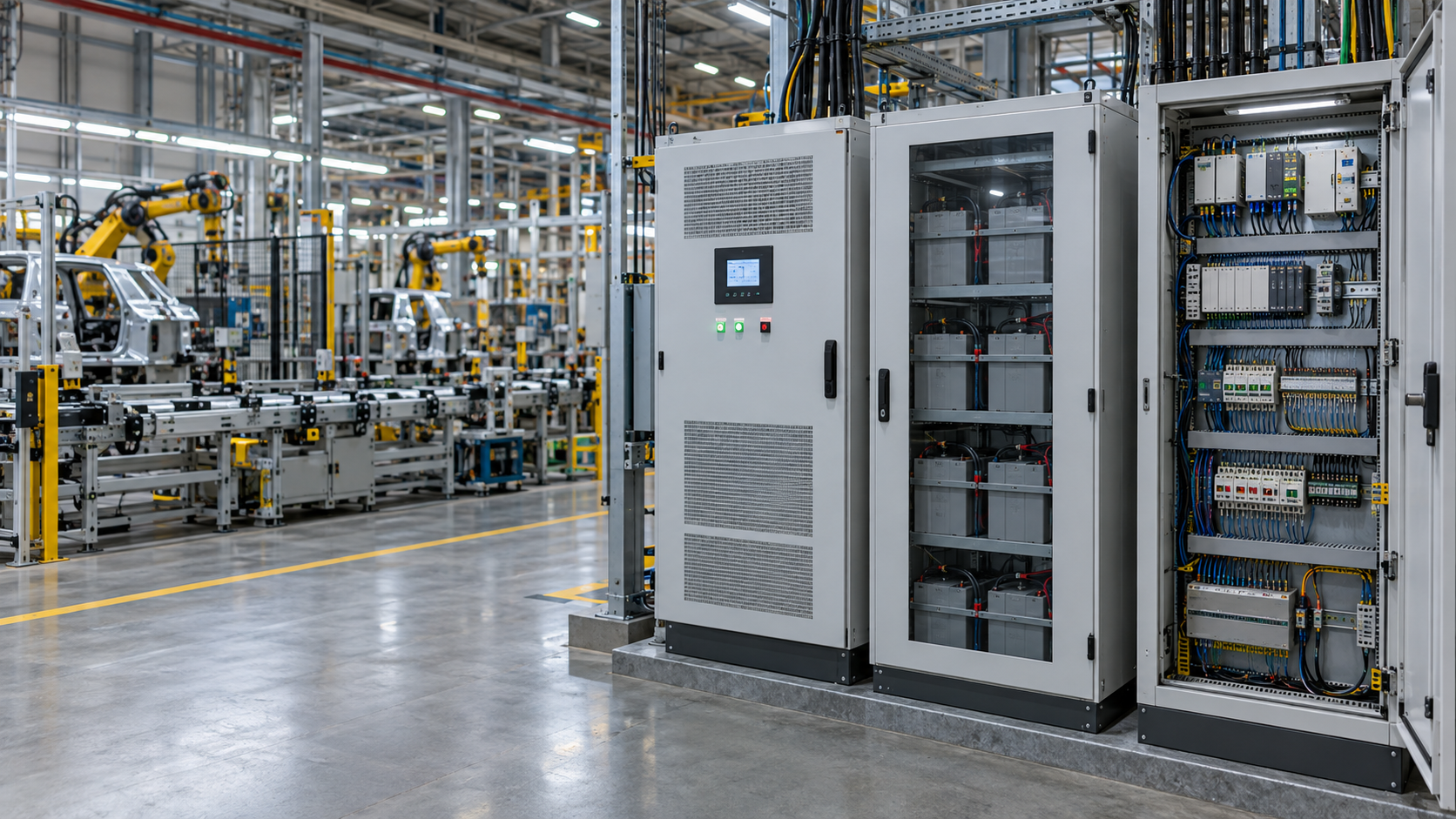
A factory may lose electricity for only a few seconds, yet restarting its production line can take much longer. Modern facilities depend on stable, continuous power for PLCs, control panels, sensors, communications devices, industrial computers and safety systems as well as motors.
UPS, rectifiers, batteries and industrial DC systems have been part of EKA System’s work for many years. Their value in factories is clear: the aim is not necessarily to run every load for hours, but to protect critical control and automation infrastructure from interruption or allow it to continue in a controlled way.
Why can a short outage become a long stoppage?
Equipment on a production line does not respond to an outage in the same way. Some devices resume automatically when power returns, while certain controllers require a restart. Even one communications device shutting down can interrupt the connection between a PLC and field equipment.
When a process stops midway, restarting it requires more than restoring electricity. Operator checks, fault resets, machine synchronisation or re-establishing safe startup conditions may be necessary.
Does every load need a UPS?
No. Supplying an entire factory through a UPS is unnecessary in many applications. The key is to identify which loads truly need an uninterrupted supply.
UPS or DC backup can be used for controls, communications equipment, automation panels, critical measurement devices and certain safety systems. Large motors and high-power process loads are assessed using different backup scenarios.
Why does battery selection matter separately?
A backup system is more than a UPS or rectifier. The battery bank is one of the main components that keeps energy available after a mains failure.
Capacity must be selected by considering total critical load, required autonomy, minimum system voltage, ambient temperature and battery discharge characteristics together. Selection based only on Ah capacity is insufficient.
To prevent a few seconds of outage from becoming hours of production loss, the key question is which systems must keep operating at the instant power fails, as well as how long the outage may last.