
How do mobile base stations keep working during a power failure?
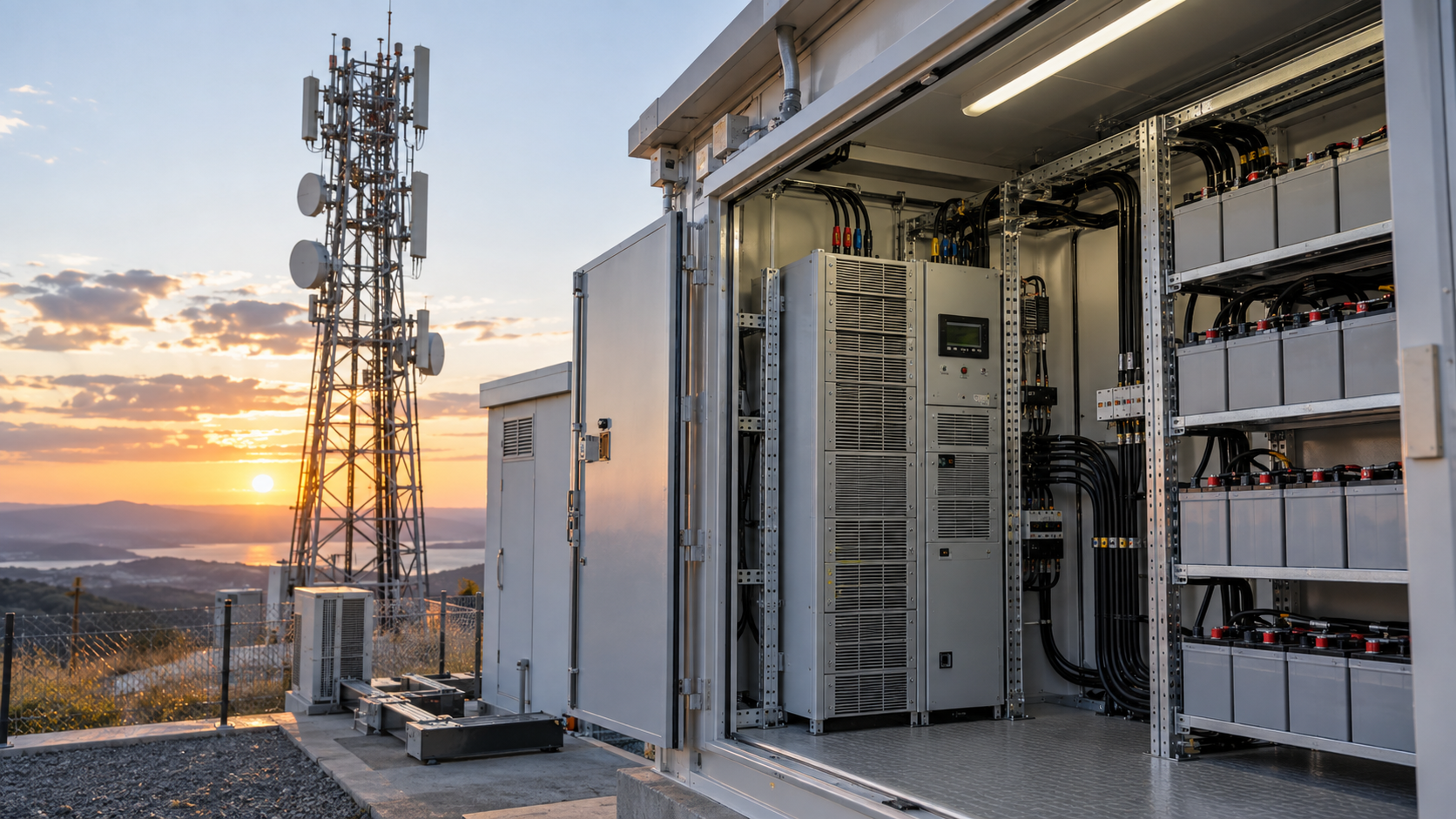
A mobile phone does not necessarily lose its signal immediately during an outage because base stations do not depend solely on mains electricity. At many telecom sites, battery banks and suitable backup infrastructure keep communications equipment powered for a time after mains loss.
DC power systems, battery solutions and backup-power applications are part of EKA System’s work. Telecom infrastructure is a familiar example of the everyday value of uninterrupted power: electricity has failed, but communications can continue for a time.
Which base-station devices need power?
A base station consists of more than antennas. Radio equipment, transmission devices, controllers and auxiliary systems may be installed on site. Much of this equipment operates from a DC supply.
During normal operation, a rectifier or power system converts mains AC to the required DC voltage while maintaining battery charge. When mains power fails, batteries continue to supply the DC bus.
How long do the batteries last?
There is no single answer. Autonomy depends on total load, battery capacity, battery age and condition, ambient temperature, system efficiency and the site’s power architecture.
At some sites, batteries only bridge short interruptions. More critical sites or locations exposed to prolonged outages may include generators or other backup sources. Batteries then maintain communications during generator startup as well.
Why does temperature matter?
Base stations are not always installed in ideally climate-controlled rooms. Temperature changes affect battery performance and service life. Technology selection must therefore consider site conditions and expected duty, as well as rated capacity.
Telecom backup systems aim to prevent communications from stopping as soon as the user notices an electrical outage. With correctly sized rectifiers, DC distribution and batteries, a base station can continue its duty after mains power disappears.