
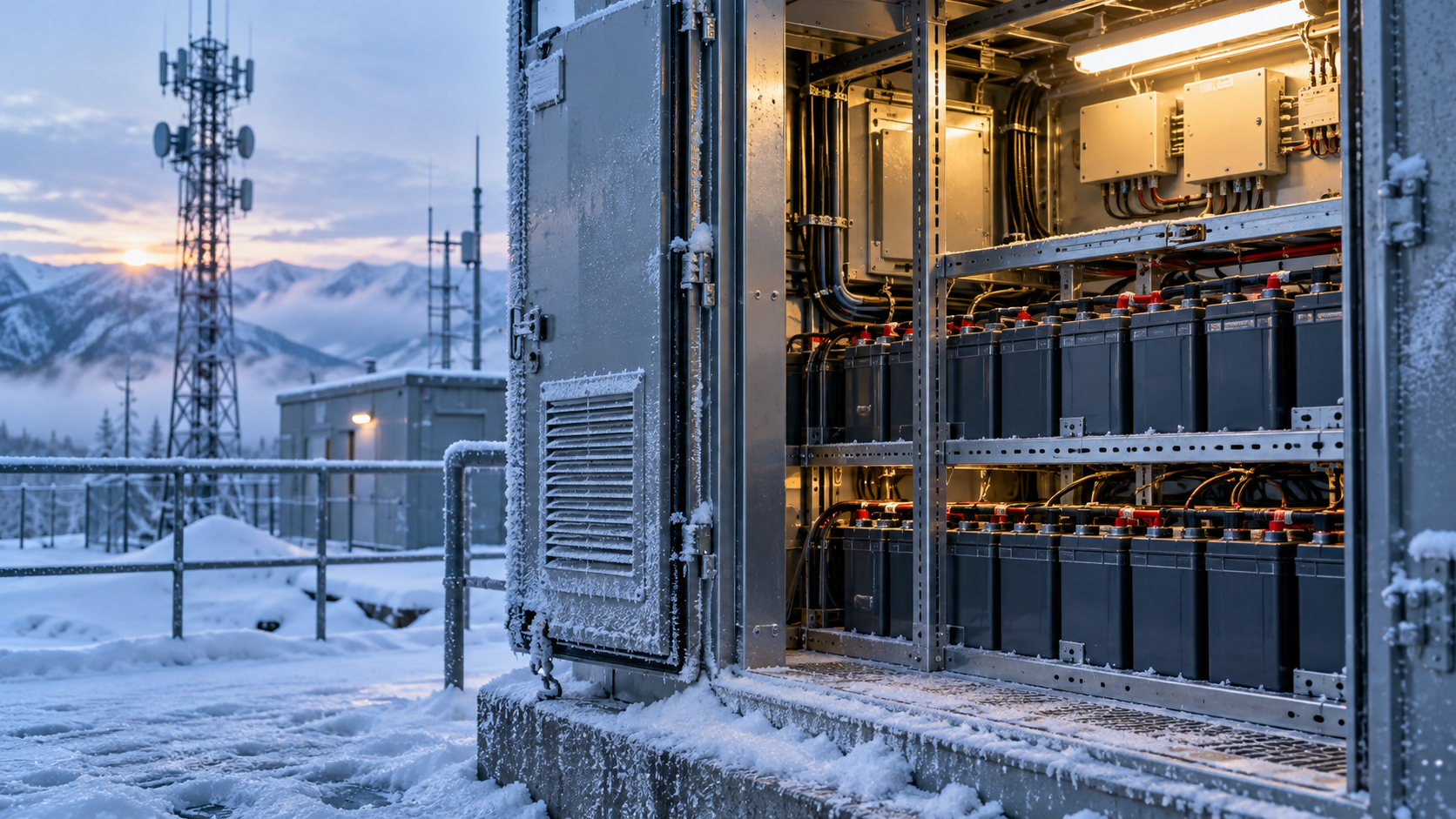
Cold weather slows electrochemical reactions inside a battery. Even when it is not empty, a battery can provide less usable capacity and lower current performance than under normal conditions. The extent depends on technology, temperature, discharge duration and the severity of the load profile.
Batteries, UPS and industrial DC systems have been part of EKA System’s work for many years. Temperature directly affects selection for outdoor substations, railway applications, telecom sites and technical spaces without adequate climate control.
What changes in the cold?
A battery releases energy through chemical reactions. As temperature falls, reaction rates and ion mobility inside the cells decrease. The same battery may therefore be unable to deliver its full nominal capacity under the same discharge conditions at a low temperature.
An Ah rating alone does not describe actual field performance. Manufacturers state capacity for specified temperature, discharge duration and end-voltage conditions. Sizing must account for temperature correction when site conditions differ from the reference conditions.
Why does battery technology matter?
Lead-acid and Ni-Cd batteries are not affected equally by low temperature. Temperature changes the performance of both technologies, but their discharge characteristics and low-temperature behaviour differ. Initial cost or nominal Ah capacity alone is therefore an insufficient basis for industrial selection.
For very low temperatures, the manufacturer’s discharge tables for the relevant temperature must be reviewed. Greater battery capacity, appropriate battery heating or cabinet temperature control can be considered where necessary.
Charging must also be considered
Temperature affects charging as well as discharge capacity. Unsuitable charging voltage and temperature conditions can reduce performance and service life. Some systems therefore use temperature-compensated charging based on the manufacturer’s recommendations.
A battery lasting less time than expected in winter is not necessarily faulty. Assessment should consider battery technology, actual temperature, load current, discharge duration, end voltage and age together.